The Hidden Side of a Celtic Cross
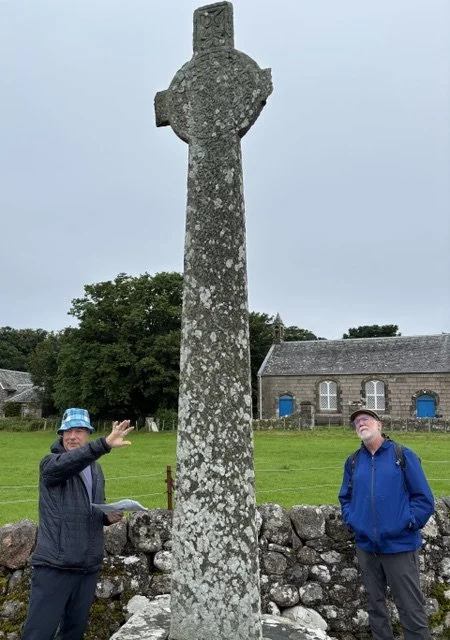
Greg Rickel and a fellow traveler
When you go on pilgrimage, you can count on seeing something you didn’t expect. So said my rector, Josh Condon, when I told him about our summer travel plans. He was right. Earlier this month, as Jill and I walked the footpaths of ancient Celtic saints in Scotland and England, more than one surprise awaited us.
One of the “high crosses” we encountered on Iona, an isle off the Scottish coast, became one such instance—a lesson that held something hidden at first, and then in an instant something momentous, moving. One of many insights on the trip.
***
Getting to Iona itself took some determination. After a long bus ride from Glasgow, you board a ferry to the Isle of Mull, travel on bus again across the island, and then catch a smaller ferry over the Sound of Iona. You have to want to get there.
As you approach, ancient stone buildings—including the many-centuries-old Abbey church—rise on the horizon. Even beneath a drizzly sky layered and weighed with pewter clouds, the island radiated a sense of holiness, the outline of the Abbey church conveying a simple majesty.
On our second morning, our guide, Greg Rickel, led us to one of Iona's famous high crosses, towering some twelve feet above us. It was an appropriate place to stop. Medieval pilgrims, arriving by boat centuries ago, would have paused here to pray before making their way to Iona Abbey and the shrine of St. Columba. And here was the surprise.
At first glance, the cross is subtly striking in its beauty. Even with its being weathered by more than five centuries, spotted with lichen, you can see the intricate Celtic knotwork. And more than interlocking geometric patterns.
Look at the intertwining vines, our guide said, the interlacing foliage. Then he invited us to look at the other side.
I maneuvered around. And there I saw a rough-chiseled Jesus hanging on a cross. Hard-hewn, almost jarring in its jagged simplicity, conveying a stark picture of suffering.
The view from behind told a story. The symbolism didn’t take much time to sink deep. On the one side, beauty, abundance, and fruitfulness greet the eye. On the other stands the agony that made such life possible. Behind the life and loveliness lay self-giving kindness. Behind the flourishing vines loomed the hard wood of crucifixion’s cross. Behind the promise of resurrection stood the ultimate sacrifice.
The victory over death announced by Jesus’s cross and the empty tomb is what makes the beauty on the front possible.
I already knew how the Celtic Christians admired the flowing, interlocking lines and winding vines of pre-Christian art. Instead of rejecting those familiar designs, they filled them here with new meaning. They adopted the unbroken patterns to suggest a new kind of eternity—a flourishing that could not be stopped by death. And this was no dull, endless existence. Their vision of eternity owed its meaning to the cross and the resurrection. The flourishing foliage grows out of the suffering Christ willingly endured. It stems from God’s extravagant giving of Son and self.
***
“Be sure to slow down at times,” my rector had said. “The more you notice, the more you will discover.” So I’m continuing to reflect on what I saw and heard. I’ll be sharing more in this space. But for now, I need to keep processing and continue praying to allow what I encountered not to slip away too quickly.
And I wonder: How might the trips you have taken and will take become not only a tourist’s trek but also a pilgrimage—a walking within and toward some insight God has been readying for you all along?
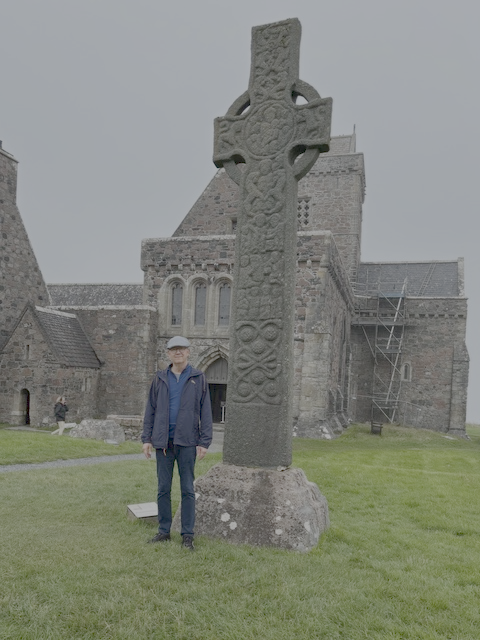
Me, standing by another Iona high cross, St. Martin’s Cross