Photo by Greyson Joralemon on Unsplash
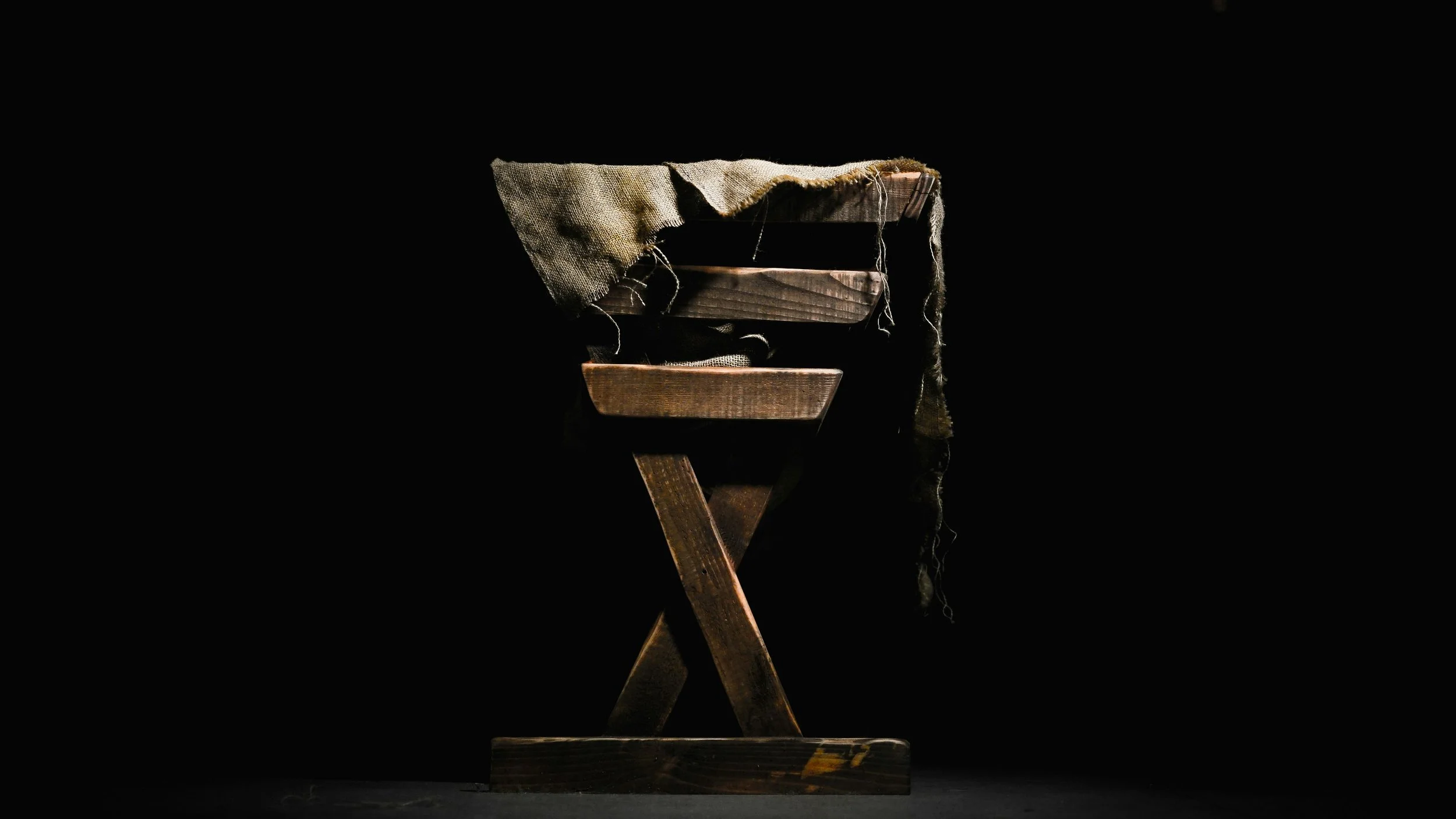
Our family has a crèche, a nativity scene, carved from olive wood. I got it many years ago when I visited Israel as a magazine editor and writer. I had to think about suitcase space for my return trip, so it’s not the most elaborate. The tallest of the figures, one of the wise men, measures barely six inches. The baby Jesus and manger stretch less than three inches, about the size of a toddler’s hand.
But the figures make a striking scene.
We love pulling it out every year. From almost the beginning of our married life, Jill and I started a tradition of setting up the crèche scene in Advent, when we decorate our Christmas tree.
But some time ago we learned of an ancient variation (tracing back to St. Francis, in fact): You don’t put the baby Jesus into the manger until Christmas Eve (or Christmas itself). You set out the rest of the characters but hold back the Jesus figure. When the infant does get placed in the manger, you are honoring that special night, the holiness of it, the climaxing arrival of the key player in the story.
So this weekend we will set up the crèche, all the figures in place, except for the baby.
And we will probably chuckle about a complication we’ve occasionally had: We set out the crèche (and the ornaments and mantle decorations), and while putting away the boxes, we take the little Jesus and put him in a drawer, a safe storage place. And because we do that weeks before Christmas, the big day comes and we find ourselves saying to one another, “Where did we put Jesus this time?”
We rummage around drawers and have to go on a hunt for the little figure buried in all the stuff that goes along with our lives.
Bekah, by the way, our youngest, perhaps the least caught up in the flurry of the season, always seemed to remember the place we put him.
I see a bigger picture here. Advent, these days leading up to Christmas, can be a season of getting in touch with what we’ve lost. A sober time to ask if we need to look again for someone we keep missing amid all that distracts or captures our attention.
I don’t intend yet another screed against seasonal excess, but I do mean to reclaim a key meaning: Advent invites us to prepare—to receive One who has already come, even though we might have missed it. Missed him. And then feed our imagination on One who is coming again.
For our longing for something more lingers. At a level deeper than the bustle and hustle, we sense an ache to relate. To reclaim something more personal. Advent reminds to wait for one who is yet to come in all his fullness, in the here-and-now and also the not-quite-yet. Until he returns at the end of time, we can forget to expect him to keep showing up.
But Advent literally means appearing or coming. How can we do better at not missing that living presence? I’m wanting to be more alert, more awake to the One who has come, sometimes, it seems, hiddenly, other times with a force that rends the heart or gives a stab of emotion or flash of longing.
Advent could help us not leave the main character in some corner of life, covered over by the clutter. Through practices and prayers we stay on the lookout. Amid all that distracts or detracts, we stay alert. We try to see the presence of Christ in our midst. The bright-lit possibilities.
They Ran After Idols
The people of God faced a not-so-different challenge in Isaiah the prophet’s time. They had run after idols, made other gods important, and barely noticed when they’d overlooked or forsaken God. Isaiah says for the people, crying out, “There is no one who calls on your name, or attempts to take hold of you” (Isaiah 64:7a).
And they are about to recognize what they now miss, the closeness with God they’ve lost amid their defiance: For Isaiah mourns, “You have hidden your face from us and have given us over to our sins” (64:7b).
Poignant, isn’t it? God seems to hide for a time.
But not only will they lament, far from their homeland, packed off into exile by the conquering Persians, their very circumstances will now stand their souls at attention. For even then God was working, seeking them out like a patient father, a loving parent with an aching heart. Isaiah tells them that God had not quite given up. They had lost sight of him, not the other way around.
And so hope arrives with the judgment: “From ages past … no eye has seen any God besides you, who works for those who wait for him” (64:4).
By looking, and by letting God find them, they would start again. And we, too, can ask the God we may have lost sight of to find us. To become again our ultimate hope.
Can you remember to do that this Advent? To ask God to find you yet again and help you make your way back? Or is it that he will just convince you that you have been found.
And one practical note. I’ve become aware of a harmful personal habit, one that crowds out time for reading, for hobbies, for praying and relating with those I love. I mean an unboundaried turning to my smartphone. Maybe you can identify. Like many addictions, the rewards, the shot of dopamine from a social media “like,” dwindle all the while the personal cost increases.
And I think it’s easier now to lose focus, to forget. For decades we’ve experienced an Internet glut of tantalizing information and accumulating facts. But now, Artificial Intelligence has intensified our plight. It accelerates our spiritual forgetfulness, our doomscrolling, with the abundance of data more like an avalanche, a dehumanizing Apocalyptic Intelligence.
And carrying our hand-held devices around makes it harder and harder to set limits or practice moderation. And pay attention. I’d pretty well concluded there wasn’t much to be done.
But then I read “In Praise of Analog Hours,” by my friend Heather Cadenhead. “I realized,” she wrote, “that my phone was no longer a tool. It was, for me, a vice.” She began “to think about intermittent technology fasting—or ‘analog hours,’” as she referred to them, “in the way that some people think about fasting from food.” Her story made me able to visualize changes in my own life. I, too, could make more room for life-giving spaces and times.
I decided to stay off my iPhone, barring an emergency, from 7 pm till 7 am. I could then be more present to my wife in the evening when we’re home. I’d have more time to practice music and do hobbies. I’d find snatches of time to pray more.
I was surprised at the joy that accompanied that little twist in my habits. And while I haven’t been perfect at my new practice (today wasn’t a good day in that regard), the benefits are keeping me at it.
Perhaps that could be one little way into the Advent joy you and I hope for. Watch for others! May God lead you to what he might have in mind for you.
Isaiah had a vast picture in view, but our little step matters, too. Some small shift of habit might help us find something good amid the season’s bleary-eyed, hurried blur. God can help, and grace can enable you not to misplace the One who matters more than any.