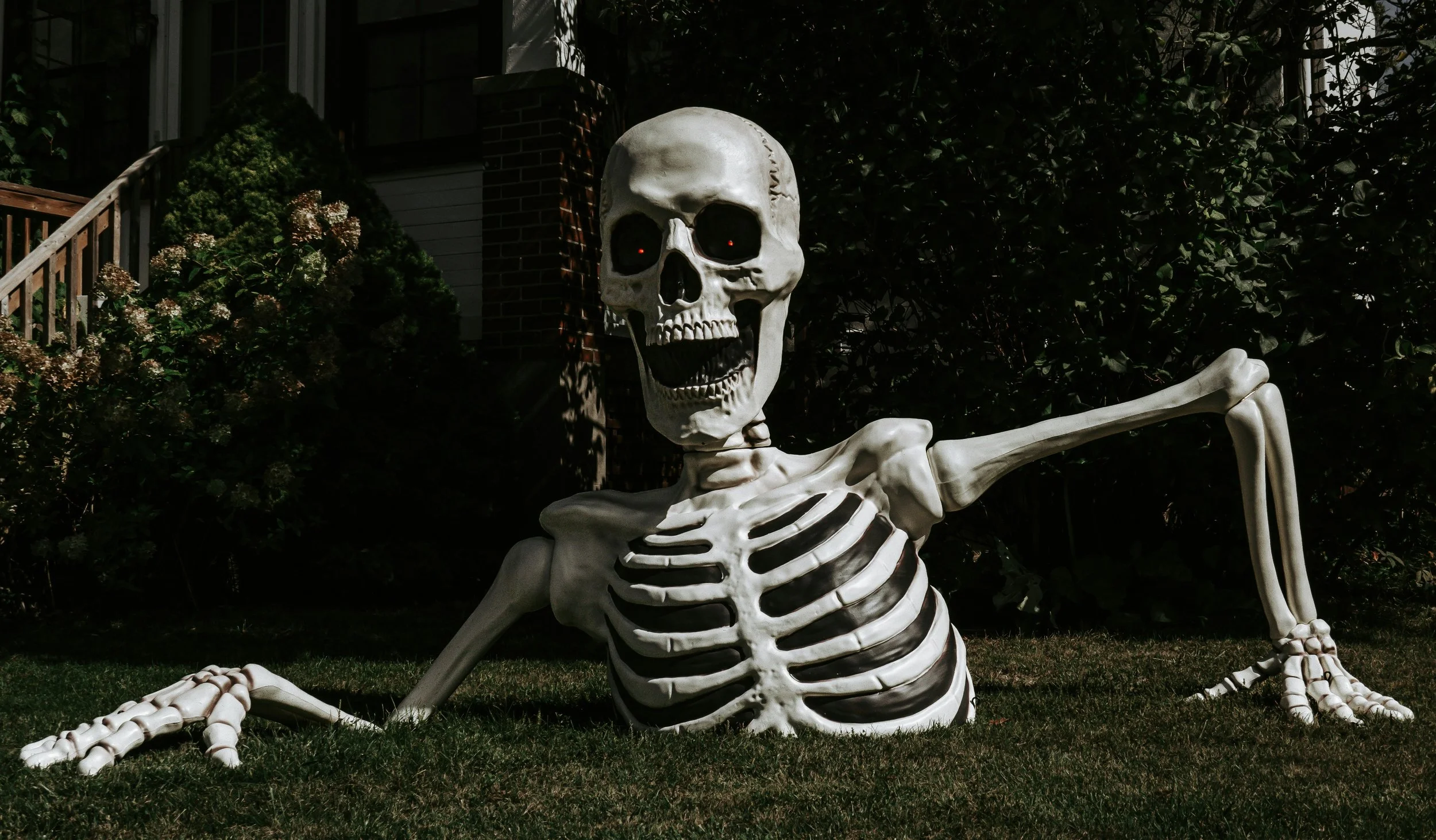
Photo by chris robert on Unsplash photo credit
Driving through our neighborhood the other day, Jill and I saw a Halloween-themed lawn: A skeleton rib cage, boney arms, and a skull were made to look as though the torso was pushing up and out from the ground, some poor ghoulish soul trying to escape a dark, worm-riddled fate. My neighbor hoped for a touch of humor, I guess, amid the morbid and macabre.
And Jill made a comment that struck me. “I’m glad people don’t come out of their graves like that.” Emphasis on like that. She meant it, but it was a funny line, too, in a way. “On the last day,” she continued, they (we) will be released from death’s captivity, “but that’s not how we will look.”
I’m glad for that. Thanks be to God.
Just before, no doubt feeding into our conversation, we’d heard a sermon about Jesus’s parable of a wedding banquet to come. Josh, our rector, had been saying that suitable garments will clothe us at that great feast. Jesus, in that Sunday’s reading from Matthew, looks beyond just feasting on earth. He also envisions a heavenly banquet—a destination in the life to come. No moldering or exposed bones on that day!
Rather, we will be wearing something appropriate for a celebration, to say nothing of having a body freed from the effects of decay. And the things that eat away at life and joy now? Left behind when we rise.
Earlier today, thinking about these thoughts, my playlist happened to pop up the great Julie Miller song “All My Tears” (also recorded masterfully by Jars of Clay.) The tears in the song title will be washed away so thoroughly that, as the lyrics continue, it won’t matter “where you bury me.” The wounds of this world (and the deteriorating effects of the grave) will be healed. We will be restored.
All of this is more than optimism or some vague picture of a soul merging into an eternal cosmic whole, jettisoning its individuality. No, our human life is too dynamic for that, for one. And for another, the effects of death are too harsh, the bodily decomposition too real.
And that prospect helps us now in our worst fears, for what we feel in our gut. As Ernest Becker put it in The Denial of Death, humankind has “an awareness of his own splendid uniqueness … yet he goes back into the ground a few feet in order blindly and dumbly to rot and disappear forever.” No wonder we crack morbid jokes as a diversion. And there are moments when I consider my own death with a pang of anxiety, a jab of recognition. There are unknowns we face there.
But Becker’s scenario is not complete, of course, not with the picture a Christian holds. Jesus shed his grave clothes. His wounds became scars. The sealed tomb got opened. And the scene of suffering death on the cross is conquered, turned around. That is no mere historical happening (though it is that). It’s also a promise to us, an assurance in our uncertainties. Death there conquered gives everything—including our own losses of loved ones—a better, glimmering scene to contemplate. Because that breach has been broached, the ending of mortal life now looks radiantly different.
“Where, O death, is your victory?” asked Paul in the New Testament, rhetorically, convinced that the taunt was warranted. “Where, O death, is your sting?” I love the resounding answer he gave: “The sting of death is sin, . . . But thanks be to God! He gives us the victory through our Lord Jesus Christ.”
I don’t think we ponder enough how much everyday reality has changed since that wonderful reversal, that infusion of life, that downpayment on our future rising to life.
In the next months, I will be focusing my reading and studying on how God made Jesus alive again in the power of the Spirit. Because of that, I expect I can worry a bit less about being lowered, when the time comes, into the ground.
Update on My Doings and Goings
In less than three weeks I head to Oxford to be a Resident Fellow at the C. S. Lewis Study Centre/the Kilns. I will be exploring Lewis, the Resurrection, and the Renewal of Our Imagination. No doubt some of that experience will find its way into my writing about Jesus’s resurrection life in the here-and-now, to say nothing of our hope of future glory. https://www.cslewis.org/ourprograms/thekilns/
Earlier this month I had a great time at Rabbit Room’s Hutchmoot co-presenting a session with singer-songwriter Matt Wheeler on “The Ache Beneath the Art.” We explored why those involved in creative pursuits sometimes feel vulnerable, and habits that help.